A Defense of the Nicene Definition (De Decretis) by St. Athanasius
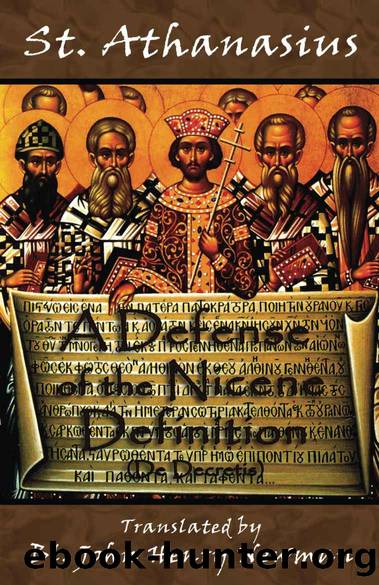
Author:St. Athanasius
Language: eng
Format: epub
Publisher: Assumption Press
Published: 2014-04-21T00:00:00+00:00
Chapter 5.
26. Now the Eusebians were at that former time examined at great length, and passed sentence on themselves, as I said before; on this they subscribed; and after this change of mind they kept in quiet and retirement; but since the present party, in the wantonness of impiety, and in their wild vagaries about the truth, are full set upon accusing the Council, let them tell us, I repeat, what is the sort of Scriptures from which they have learned, or who is the Saint by whom they have been taught, to heap together their phrases, âOut of nothing,â and âHe was not before His generation,â and âOnce He was not,â and âAlterable,â and the âPre-existence,â and âAt Godâs will;â which are their fables in mockery of the Lord. Considering then that they on their part have made use of phrases not in Scripture, and that with a view thereby of expressing impious notions, it does not become them to find fault with those who for a pious purpose go beyond Scripture. Disguise it as you will by artful terms and plausible sophisms, impiety is a sin; but represent the truth under ever so strange a formula, while it is truth, it at least is piety. That what these Christ-opposers advanced was impious falsehood, I have proved both now and formerly; that what the Council defined was pious truth is equally clear, as will be granted by any careful inquirer into the occasion of the definition. It was as follows:â
27. The Council wishing to condemn the impious phrases of the Arians, and to use instead the received terms of Scripture, namely, that the Son is not from nothing, but from God, and is the Word and Wisdom and not a creature or work, but the proper Offspring from the Father, the party of Eusebius, out of their inveterate heterodoxy, understood the phrase from God as common to Him and to us, as if in respect to it the Word of God differed nothing from us, and this, because it is written, There is One God from whom all things;[52] and again, Old things are passed away, behold all things are new, and all things are from God.[53] But the Fathers, perceiving their craft and the cunning of their impiety, were forced thereupon to express more distinctly the sense of the words from God. Accordingly, they wrote âfrom the substance of God,â in order that from God might not be considered common and equal in the Son and in things which are made, but that all others might be acknowledged as creatures, and the Word alone as from the Father. For though all things be said to be from God, yet this is not in the sense in which the Son is from Him; for as to the creatures, âfrom Godâ is said of them, in that they exist not at random or spontaneously, nor come into being by chance, according to those philosophers who refer them to the combination
Download
This site does not store any files on its server. We only index and link to content provided by other sites. Please contact the content providers to delete copyright contents if any and email us, we'll remove relevant links or contents immediately.
The Lost Art of Listening by Michael P. Nichols(7506)
Why I Am Not A Calvinist by Dr. Peter S. Ruckman(4153)
The Rosicrucians by Christopher McIntosh(3519)
Wicca: a guide for the solitary practitioner by Scott Cunningham(3178)
Signature in the Cell: DNA and the Evidence for Intelligent Design by Stephen C. Meyer(3138)
Real Sex by Lauren F. Winner(3022)
The Holy Spirit by Billy Graham(2952)
To Light a Sacred Flame by Silver RavenWolf(2823)
The End of Faith by Sam Harris(2742)
The Gnostic Gospels by Pagels Elaine(2531)
Waking Up by Sam Harris(2460)
Nine Parts of Desire by Geraldine Brooks(2369)
Jesus by Paul Johnson(2362)
Devil, The by Almond Philip C(2331)
The God delusion by Richard Dawkins(2309)
Heavens on Earth by Michael Shermer(2284)
Kundalini by Gopi Krishna(2184)
Chosen by God by R. C. Sproul(2164)
The Nature of Consciousness by Rupert Spira(2108)
